29 October 2021
The Rafiki Project is an initiative by FareShare Greater Manchester and the MCR BME Network CIC, in collaboration with GM BAME Network, to provide more culturally diverse foods to communities experiencing racial inequalities in the Greater Manchester area.
It currently engages 17-20 organisations across the MCR and GM BAME Networks, each of whom provide food for between 30 and 100 families a week.
“There’s just more dignity than having to queue at a place where people don’t know you and don’t understand the kinds of foods you need.”
We spoke with Atiha Chaudry, Chair of the GM BAME Network, who manages the Rafiki Project for the MCR BME Network. She remarks: “We’re thrilled we’ve been able to support so many families and organisations to join FareShare Greater Manchester. Greater Manchester and Manchester are places of rich community diversity, with many different cultures, faiths, languages and needs. We know there are very high levels of inequality and poverty.”
The project began during the pandemic, as the disproportionate impact on minority communities became clear: “Food is very important to helping us support communities who are dealing with those challenges. Many people are reluctant to talk about their needs. By reaching them through their own networks – our organisations really are friendship networks – there’s just more dignity than having to queue at a place where people don’t know you and don’t understand the kinds of foods you need. FareShare has helped us greatly. Not just with the food but with signposting to funding so that we can buy more ethnic food to supplement. ”
One of the organisations supported by the project is the Manchester Refugee Support Network (MRSN).
“Rafiki helps us provide a lot of the fresh fruit and veg, as well as things like cereals and eggs. It gives us something healthy to provide, and it means that people can make their own meals to their own tastes,” explains MRSN staff member Jennifer Anderson.
As Atiha elaborates: “Our families love cooking fresh, from scratch, so that fresh produce from FareShare is fantastic for them. In the summer especially we can get a great abundance of fruit and veg from FareShare – apples, strawberries, lemons, chillies and fresh veg. It helps our families eat healthier, helping towards their health and wellbeing.”
Black History Month is an important reminder of the value of the work being done through the Rafiki Project.
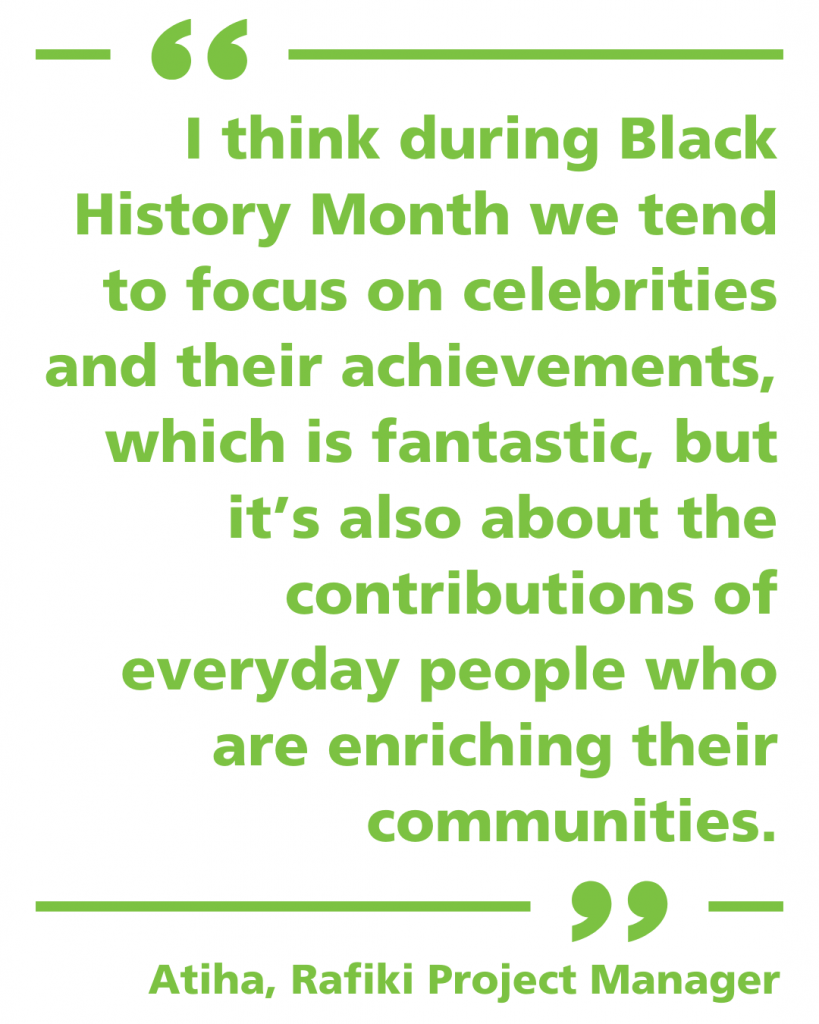
“Black History Month is a good celebration of diversity in this country and the Rafiki Project celebrates diversity,” says Atiha. “We work with a diverse range of organisations that bring out the contributions that their heritage and culture has brought. I think during Black History Month we tend to focus on celebrities and their achievements, which is fantastic, but it’s also about the contributions of everyday people who are enriching their communities.”
As Jennifer explains, that sense of connection can mean as much as the food itself: “People have been through so much, so if we can meet their needs with food that is appropriate for them it just helps restore their faith in humanity. The proof of that is after people have settled they come back to help and bring food parcels.”
As Atiha says, food is one of the most powerful ways that everyday people help build cultures and communities: “There’s great skill in our communities for cooking and preserving food, stopping it from going to waste. With projects like Rafiki you end up talking to a lot of people, learning about their heritage and their journeys. Sharing stories, sharing skills and recipes, it shows that everyday contribution that heritage and culture make.”
Atiha notes, many families are facing a difficult winter, and will need support from organisations like FareShare: “As we move into the winter months heat is critical as well as food. For families with children it can be especially difficult as there is more pressure to provide kids with what they need for school so they don’t fall behind. Providing food means they can spend their income on those things, so that these families can stay warm.”
Jennifer describes the impact she sees FareShare and the Rafiki Project having on the refugee families she works with: “People always tend to worry more about their children than themselves. When we make deliveries the children will run out, they get really excited. To see the joy on the children’s faces, and the peace on the faces of their parents, you know how much it means.”
Thinking forward, Atiha hopes that the Rafiki Project’s model will help change how we think about food provision and what it means for communities:
“I think the Rafiki Project can help us look at different models of how communities support each other. With us, food provision is a part of engaging with the community. If you have communities who understand each other’s needs, you can share what you have and bring the cost down. It’s what our organisations do: communities working together, sharing together.”